Recharging Your Team’s Batteries

Ever feel like your team is running on fumes? We’ve all been there. As Agile Coaches and Scrum Masters, we know that a motivated team is a productive team. But keeping that motivation engine humming can be a challenge.

Here is a fun activity that I’ve used with countless teams to help them understand and boost their motivation.

The “Energizers and Drainers” Activity

This activity is like a quick pit stop for your team’s motivation. It helps everyone identify what tasks and activities fuel their energy and which ones leave them feeling drained. The real magic happens when the team starts exploring how to leverage those energizers to tackle the drainers and even identify opportunities to eliminate those energy-sucking tasks altogether.

Here’s how it works:

Time: 45 minutes

Materials: A whiteboard (physical or virtual) and sticky notes.

Introduction (5 minutes):

Start by acknowledging that everyone has tasks they love and tasks they, well, don’t love so much. Explain that this activity will help them visualize these tasks and find ways to optimize their energy.

Instructions:

  1. Divide the whiteboard into four quadrants:
    • Energizers at home
    • Energizers at work
    • Drainers at work
    • Drainers at home
  2. Brainstorming (5 minutes):
    • Ask the team to write down their energizers and drainers on sticky notes, one idea per note.
  3. Sharing (12 minutes):
    • Have team members volunteer to share their ideas, one quadrant at a time.
    • (Pro tip: I usually leave “Drainers at Work” for last, as this tends to spark the most discussion.)

Debrief (15 minutes):

Now for the juicy part! Guide the team through these questions:

  • What are the common themes? Are there any patterns in the types of energizers and drainers people identify?
  • Which energizers can help us complete the drainers? Can we strategically schedule energizing tasks before or after draining ones?
  • Which drainers can we remove? Are there any tasks that are truly unnecessary or can be delegated/automated?
  • Are there pairing opportunities between team members to help each other with drainers? Can someone who finds a task energizing help someone who finds it draining?

Action Planning (8 minutes):

  • Capture any action items that emerge from the discussion.
  • Assign owners and next steps to ensure follow-through.

Why This Works

This activity is more than just identifying tasks. It’s about:

  • Open Communication: Creating a safe space for the team to share their feelings about their work.
  • Collaboration: Encouraging the team to support each other in tackling challenging tasks.
  • Continuous Improvement: Identifying opportunities to optimize the team’s workflow and boost overall motivation.

Challenge Yourself!

Try this activity with your team and see the difference it can make. Remember, a motivated team is a high-performing team!

What are some of your favorite ways to boost team motivation? Share your tips in the comments below!
My journey to become a Certified Team Coach

To celebrate my most recent certification as a Certified Team Coach from the Scrum Alliance, I would like to share the main takeaways for me along this journey.

Start with Self-Mastery

Even though I would recommend this as one of the first steps to take, I learned it’s importance late in the path.  It wasn’t until I started working with the Agile Coaching Growth Wheel that I became aware of the central role that Self-Mastery plays, and why the continuous work in this area has such a big impact in our own development as coaches.

Self-mastery is broken down in three main areas:

  • Emotional intelligence: this includes the exploration of our self-awareness, self-regulation, and the impact we have on the systems that we interact with.
  • Balance: By achieving a healthy balance between work and personal activities, we become aware when we are stepping out of it and develop the skills to center ourselves back into balance.
  • Personal transformation: If we, as Agile Coaches, expect our clients to embrace chance, we must model it ourselves first.  If we invest in our own growth and learning, and then integrate all this into actions, we will be able to catalyze the change we want to see in organizations.

If you would like to explore more that this and the other competencies of the wheel, you can start here.

Build a network

Getting the certification is an individual work, but that doesn’t mean that we won’t need help.  Finding a user group or a community of people that can support us when we are running out of energy is key.

You can find groups through MeetUps, Slack workspaces or paid programs that are specifically design to help navigate through the application while building a network of people with a common interest. Through this groups we can will find the opportunity to work with others going through the same experience and are willing to give honest feedback to improve.

Find a mentor

Having someone more experienced that can advise us on specific aspects of the application is a great way to move forward in the process.  For me, it was hard to find a mentor at first because my income did not allow me to pay someone to help me out. Also, my network wasn’t big enough to find someone that could help me for free.

As I started building my network, I was able to find kindhearted people that would help me out and guide me through the application process. I will always be thankful to their generosity and for believing in me. Which is why I am committed to return the favor to other going through the same experience and help in any way I can.

The bottom line

In conclusion, if I were to do it all over again (which I probably will for my CEC), I would start with myself, developing and honing my own craft and my own self-awareness.  Then, I would move to expanding the network around me to find likeminded people that I can learn from and that are willing to support my journey.

Please keep in mind that I’m only sharing my own experience. The list above may not work for you at all, or maybe just an item or two might be helpful for you. If you would like to experiment with any of them, I would love to hear about your results.

Takeaways from the CAL E+O

I recently went through the CAL E+O Certification with Bob Galen, who masterfully took us through an exploration journey inside the mind of the leaders and the key role they play in supporting Agile implementations. 

The hours I spent with the cohort reviewing the content where unbelievably valuable and full of rich and diverse experiences. However, after the class we were required to, individually, complete a survey which providing amazing insights towards setting growth actions. 

In this post I would like to share the most important takeaways for me at the end of the certification.  

Building self-awareness 

Through the program we were asked to take The Standout Assessment, which a free assessment that help to identify your strengths. For me, this is a great tool to improve our Self-Mastery, which an area I have been developing as part of the volunteering work I have done lately with the Agile Coaching Growth Wheel. 

If you would like to grow this core competency, I highly encourage you to take the assessment and explore how the results may impact your self-awareness, your balance and, eventually, how will it catalyze your personal transformation. 

I am certain that this exercise will help me to support better leaders as they navigate through change. 

Story telling 

Another action that I would like to start as soon as possible, is to practice my story telling techniques. This is a valuable skill that can help a lot to build empathy and get buy-in from the people we are working with. 

Through my experience, one of the biggest impediments in Change Management is a poorly communicated purpose and the leadership plays a key role in communicating the reason for change.  

If we, as Agile Coaches, can guide our leaders to improve in this skill, they will be able to convey a clearer message to the entire organization and get more buy-in into any change they would like to implement.  

First Team 

This could be a whole subject on its own, if you would like to explore this further you can the book The Five Disfunctions of a Team by Patrick Lencioni if you have not done it yet. What I found remarkably interesting about this is the potential to remove silos within the organization.  

I have been in several instances where the leaders are extremely focus on their work and the teams they work with, but they dismiss talking to their peers. This causes conflicting priorities and misaligned objectives. 

By creating a leadership team that moves through regular cadences of transparency, inspection, and adaptation they will be able to guide their teams through clear goals and continuous improvement. 

The Bottom Line 

So, to summarize, through the class I found value in:

  1. Working on our own growth 
  1. Focusing on deliver a clear and inspirational message 
  1. Inviting our peers to work together in bringing joy into our workplace 

I would like to challenge you to choose one of your personal growth actions and explore how it could impact the teams you are working with.

The Bagage I take with me

I recently had the opportunity to switch companies and venture into a new contract. Along with farewells and well-wishes came gifts. I will always appreciate the care and detail that everyone showed, especially in a gift they gave me that held a hidden, powerful message.

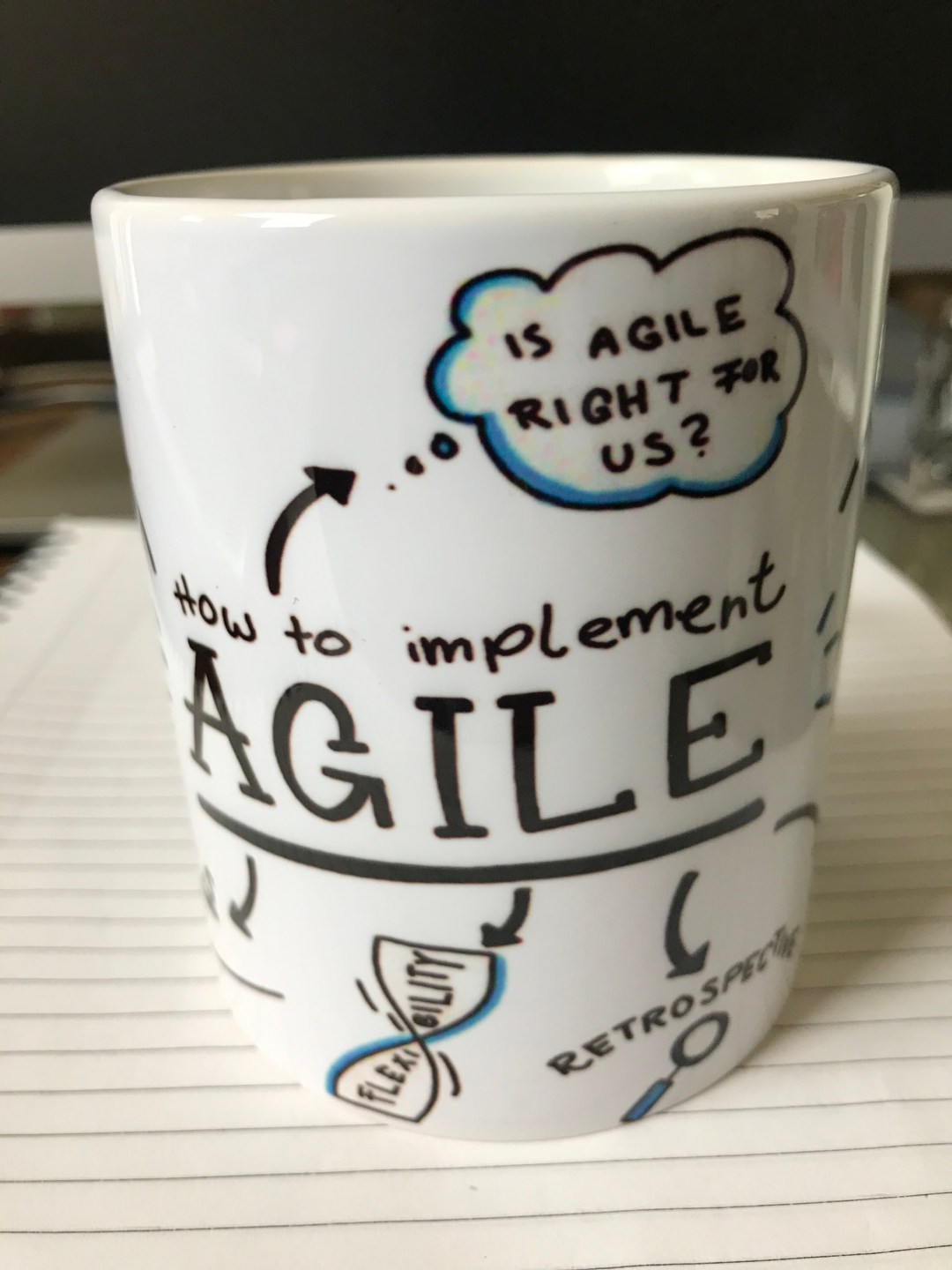
During my time at this company, I worked closely with a group of RPA (Robotic Process Automation) developers. A developer gifted me a coffee mug (which I’m sharing in the image), on which she included all the elements of Agile and Scrum that could fit on the mug. However, one thing caught my eye: the question “Is Agile right for us?”

When I read this, I couldn’t help but feel pride, peace, and a touch of satisfaction. There are two reasons, that I could identify, that triggered these feelings.

Firstly, the simple fact that they had the courage to ask me that question shows that the team is mature enough to openly challenge my own role on the team. This is done with the confidence that no one will take offense as the question comes with good intentions.

The second reason was that, despite questioning whether Agile is what they need, they decided to continue down this path. The team appreciated the culture that Agile brings, such as having open discussions, collaborating together, and challenging each other’s viewpoints.

Once I processed this, I knew that I could leave with the confidence that they will continue seeking opportunities to continually improve their development process while supporting one another. All of this inevitably leads to a sense of satisfaction, knowing that the guidance one has provided is welcomed and valued.

Many thanks to the FPR team for all the lessons you taught me. Until we meet again…

Managing the 4 Toxins Of Communication

One of the most common complaints teams share during retrospectives is “lack of communication” or “communication issues,” which has been investigated and documented for decades. However, when I challenge teams to be more specific about the type of communication that is difficult for them or that presents problems, they struggle to identify them.

While experimenting with this, the exercise that has been most effective is based on the Four Team Toxins, which I first encountered on a site curated by Bob Galen about ORSC (Organization and Relationship Systems Coaching). These 4 toxins were identified by relationship expert Dr. John Gottman, who noticed certain behaviors that get in the way of effective communication and relationships: Blame, Defensiveness, Contempt, and Stonewalling.

According to Conway’s Law, the products we deliver are copies of the communication structures within organizations. Therefore, if we can improve the way we interact with each other, we will enhance the value delivered to our clients.

So, what can we do…

The first thing I ensure is that the team has worked together to craft their social contract or working agreements, where they agree on how to deal with different situations that might arise while working together. This way, we can use this artifact to anchor our conversation about the toxins with the team.

The next step I take is to ask each person to individually write down any behavior they might engage in that could jeopardize at least one item in the Social Contract. I usually leave the option open for sharing their findings with the group as this depends on the level of trust within the team.

Now, we match each behavior with one of the four toxins and begin the conversation about how they manifest:

“I prefer working alone, I don’t need help” (Stonewalling, perhaps?)

“I don’t like it when people tell me I did something wrong” (Defensiveness!)

“This is terrible, your code is a mess…” (Contempt… bordering on bullying)

“It’s not my fault, the other teams always send last-minute requests” (Blame)

This way, from a coaching standpoint, we reflect the team’s findings back to them so they know how each toxin looks in real life.

The Antidote

Now our conversation shifts toward developing the antidote for these toxins. As a team, we share actions we can take to address the toxic behaviors that were identified. With this information, we can show the team how to individually avoid these behaviors and how to support each other as a team in this effort. And even how they can set an example for the rest of the organization.

To wrap up…

At this point, the conversation turns toward how they have the power to identify very specific situations that threaten communication and that they don’t need anyone to keep them in check because they can now spot these behaviors long before they happen, know what actions to take, and how to support each other.

My Favorite Catalyzers (Part 3)

CONTINUOUS IMPROVEMENT

In the two previous installments, I shared two of the three catalysts I use as focal points in my interactions with teams and organizations. To conclude, I’ll share the third one, and it’s likely the one that brings the most lasting and impactful change: Continuous improvement.

Continuous Improvement

Continuous improvement through ongoing learning is the catalyst where I challenge the team to take charge of their future by setting key milestones they want to achieve together. Retrospectives have proven to be an ideal space for a rigorous brainstorming session.

This way, we can identify learning opportunities like cross-training, where each team member shares their knowledge with others. This practice helps level the technical knowledge within the team and takes it to the next level.

Through this effort, empathy within the system increases as team members support each other. One way to enhance this catalyst is to let the team self-organize and design their own learning activities, challenging each other to sustain the change.

Interestingly, of the three, this catalyst presents the greatest challenge when it comes to identifying metrics. After working with several teams and facilitating multiple workshops on the topic, we’ve identified the following metrics:

  • Skills matrix
  • Agility maturity level
  • Code quality
  • Product quality
  • Completed improvement tasks
  • Employee turnover

Conclusion

By focusing on these three catalysts, sustainable change in the company culture can be achieved. This can manifest in increased customer value delivery and greater alignment of individual goals with company objectives. Most importantly, it leads to more fulfilled individuals, creating highly motivated people with ambitious goals for their professional growth.

Thank you very much for taking the time to read this far. I invite you to share what your catalysts are and what changes you’ve noticed in your teams.

See you…

My Three Favorite Catalyzers (Part 2)

FEEDBACK

In the previous installment, we talked about Process Analysis as a catalyst or agent of change. Now I’m going to share with you how we can use feedback to achieve sustainability in the implementation of agility within an organization.

But first… What is a catalyst?

I find it important to quickly revisit what a catalyst is. After reviewing various definitions, the one that caught my attention the most is: a catalyst is a substance that can produce or accelerate a fundamental change in a system without being consumed in the process.

What stands out to me in this definition is the fact that an external element, when interacting with the system, not only brings about change but a fundamental change that remains within the system. This helps make the change permanent, allowing the customer to take ownership of their own change and integrate it into the system. Quite an achievement for agile coaches.

Feedback

The second catalyst I focus on is feedback. First, I guide the team to identify both internal and external customers and to find ways to interact with them. Through this exercise, my goal is to help them see how they are perceived from the outside, the image they reflect, and the value they bring with their product.

The importance of feedback as an agent of change lies in providing the team with purpose, enhancing their sense of pride in the value they deliver. It’s important to channel feedback in three directions:

  • Towards the organization
  • Towards the customer
  • Towards their colleagues

Focusing feedback towards the organization allows the team to understand if the value they’re delivering is aligned with the company’s objectives, ensuring effective interactions with other teams in the process.

When engaging in a conversation with the customer, we ensure that the outcome of the work will bring value and that this value will be utilized, achieving growth for the organization and thus for the team members.

Finally, by focusing on their teammates, they improve collaboration within the system, leading to enhanced quality and value in their work.

Similar to the approach taken with process analysis, the team will identify metrics that enable them to understand how their interactions with these three roles are improving, such as:

  • Customer satisfaction
  • Net Promoter Score
  • Team satisfaction
  • Focus groups
  • Number of bug reports
  • Number of clicks
  • Application or feature usage time

To be continued…

In the next, and final installment, we’ll talk about the third catalyst: Continuous Improvement.

See you…

My The Favorite Catalyzers (Part 1)

Análisis del Proceso

During my process of obtaining the Certified Team Coach certification from the Scrum Alliance, the question arose about which three agents of change I use during my interactions, whether at the team or organizational level, in the implementation of agile processes.

Therefore, in this three-part installment, I’m sharing the answer I developed for the application, which eventually evolved into a talk I’ve had the opportunity to share at various events.

The ultimate goal of my interactions with each system is to bring the group to a level of trust that allows them to take ownership of their own improvement and maturation process. With this purpose in mind, I intentionally work on three elements that allow me to create a culture of collaboration: Process analysis, feedback, and continuous improvement.

Process Analysis

By mapping and measuring the process using tools like Value Stream Mapping, it’s possible to reflect to the team the points where cycle time or velocity are affected by identifying various types of waste.

Another outcome of this analysis is discussing the tasks involved in the process and categorizing them into tasks that bring value to the customer, tasks that don’t add value to the customer but are necessary, and tasks that neither add value to the customer nor are necessary to complete the process.

This way, I facilitate a process where the team designs experiments to optimize the process and define metrics that are useful for showcasing the value it brings to the organization and the customer.

Another important outcome is discovering different options the team can use to design a plan to remove impediments and form alliances with other areas of the organization to eliminate dependencies that are consuming time.

After working with various project and operations development teams, some metrics that have proven valuable to them include:

  • Cycle time
  • Throughput
  • Estimated points vs. completed points
  • Velocity
  • Waste reduction per iteration
  • Number of improvement stories in the Sprint backlog
  • Efficiency percentage

To be continued…

In the next entry, I will talk about feedback as an agent of change.

See you…

Energy Management

Have you ever felt that your teams are low on energy? You might have even noticed that interactions among team members have become increasingly aggressive. There are several indicators that often suggest the team’s energy is lower than usual:

  • Difficulty completing tasks that are typically easy for the team
  • Lack of initiative when proposing ideas
  • Limited participation in meetings (especially retrospectives)
  • Increased aggression in conversations
  • Elevated level of toxicity within the team

When any of these symptoms start to show, it might be time to gather the entire team to inspect how we are managing our energy. Thus, we seek the best moment for this exercise, which can be during a retrospective or simply creating a dedicated meeting where we can have focused time with the team.

It’s important to take a few minutes at the beginning with the team to explain that every day we do things that recharge our energy and things that drain our energy. Take a moment for each team member to individually think about how full their energy tank is at that moment. According to Tom Rath, author of “Are You Fully Charged?”, only 11% of people feel they had a lot of physical energy throughout their day.

When I’ve worked on this with my teams, I ask them to individually identify the following:

  • Tasks that recharge their energy at home
  • Tasks that recharge their energy at work
  • Tasks that drain their energy at home
  • Tasks that drain their energy at work

We put one idea on each post-it note and share them on a prepared board with the four quadrants. Up to this point, we’ve only identified data; the value of the activity comes in the next part where we start the conversation.

In this part, I focus on asking the team:

  • Which ideas are repeated?
  • Which energy-recharging tasks can help balance out the energy-draining ones?
  • Which energy-draining tasks do we need to maintain?
  • Which energy-draining tasks can we discard?
  • What actions can we take as a team to eliminate tasks that drain our energy?

Along with the four quadrants, I maintain a section on the board to identify those actions that we’ll discover as a team, which will help us boost energy levels in our day-to-day and with our teammates.

What can we achieve?

With this exercise, we might achieve:

  • Increased empathy among team members
  • Identification of waste we can eliminate in our workflow
  • Recognition of energy-draining obstacles and how to eliminate them
  • Getting to know each other and having fun as a team

If you give it a try, I’d love to hear how it goes, what you discover that you didn’t know before, and if it proves valuable for the team.

See you…

How I got started in Agile

During an interview for a book on Internal Agile Coaches, I was asked to describe in 150 words how I started my journey in this profession. This was quite a challenge for me, as I’ve been told that I tend to go into too much detail when telling a story, something I’ve been actively working on improving.

So, it seemed like a good opportunity to kick off this blog, a project I’ve wanted to start for a while. What has held me back is that I almost entirely delegated it to my inner saboteur, and it played its role perfectly.

The path that led me to the constant learning involved in Agile Coaching began with events that set me on the route of Agility…

150 words? Nowhere near…

While working for a company of around 150 people, the company’s CEO brought up the idea of implementing Scrum across all teams. I vividly remember him showing us a 7-minute video summarizing the framework; he took on the role of Scrum Master for all teams and gave the go-ahead… Scrum Away!!

Soon after, he realized he wasn’t the most suitable person to be the Scrum Master and opened the possibility for someone within the company to take on the role. I had been growing within the company and was someone they regularly turned to when there was a problem to solve, which was a great motivator for me.

However, my day-to-day tasks had been taking me away from supporting other teams, and my level of satisfaction with the tasks I had wasn’t the best. My supervisor skillfully pointed this out, and I’ll always be grateful to her for planting that doubt in my mind.

So, as soon as I heard the CEO’s announcement, I did what was needed. I Googled “Scrum Master” and immediately volunteered for the new role. The boss thought it was a good idea and gave me the opportunity to prepare for the role.

From Scrum Master to Agile Coach

As my role evolved, we realized that one person couldn’t be the only Scrum Master for the 10 teams we had at that time, spanning from Software Development to Graphic Design.

Eventually, we managed to have a Scrum Master in each team, which led me to work with multiple teams simultaneously on their Agile implementation. That’s when I realized I needed to acquire additional tools and skills to provide the support the company needed.

While I was figuring out the path I should take, I had the opportunity to work as a volunteer with the Scrum Alliance on the Coaching Advisory Team. This helped me get to know other professional coaches and agilists, giving me a much broader perspective of possibilities that gradually became my path to growing as an Agile Coach.

What I value the most in this entire adventure is all those people around the world who have accompanied me in some way and from whom I’ve learned an incredible amount. With them, I share common goals like creating a Latin American community of Agile Coaching. Others have invited me to share my experiences at their events or challenged me to be bolder and trust my abilities.

Clearly, I wasn’t going to make it in 150 words, but here’s the story. In the upcoming posts, I’ll share the experiences I’ve gained on this journey, hoping to contribute some value to others and, above all, start a conversation that helps us grow together.

See you…