Daring Leadership: From Clarity to Connection

In the ever changing world of Agile, on of the most powerful tool an Agile Coach or Scrum Master possesses isn’t a framework—it’s vulnerability. Brené Brown’s Dare to Lead provides a powerful mandate for how we can operationalize vulnerability to build the trust necessary for true organizational agility.

My key takeaway from Brown’s work is that daring leadership begins with clarity and ends in curiosity.

Be Kind: The Power of Clarity

Brown bring us down a very simple but profound truth: “Clear is kind. Unclear is unkind.” In an Agile environment, this means eliminating the ambiguity that breeds resentment and speculation. When we are clear about expectations, feedback, and roles, we act with kindness, even when the message is difficult. This clarity creates a safe foundation from which we can then be genuinely curious about others’ perspectives and challenges. Without this initial clear communication, any attempt at curiosity will feel performative or even manipulative.

Building Empathy Through Emotional Exploration

True connection and trust are the currency of high-performing Agile teams. This trust isn’t built on happy hours; it’s forged in shared emotional exploration, time and tough conversations. Brown’s work emphasizes that to build empathy, we must explore the emotions that live within our experiences. As coaches, this means moving past a simple “What happened?” to “How did that experience make you feel?”

By slowing down to acknowledge the fear, frustration, or even joy tied to a project, we build a deeper human connection. This exploration shifts the team from merely processing tasks to genuinely understanding and supporting the people performing them.

📜 The Danger of the “Story I’m Making Up”

The core danger in the absence of clarity is the human tendency to fill the void. Without clarity, people will create their own stories, their own truths. Brown calls these internal narratives the Shitty First Drafts (SFD)—the often negative, self-protecting stories we invent to make sense of uncertainty. These SFDs quickly become an organization’s unofficial, detrimental truth, leading to misaligned efforts and eroded trust.

A daring leader recognizes the patterns and behaviors that lead to the SFD phenomenon and intentionally creates a space to expose and process these stories.

Applied Daring Leadership: The SFD Retrospective

To combat the chaos of unmanaged SFDs, I came up with the SFD Retrospective as a powerful tool for coaches and Scrum Masters following a rocky period or project:

  1. Present the Situation: Clearly and neutrally define the event or project period being reviewed.
  2. Draft Your SFD: Ask each team member to individually draft their personal SFD—the story, assumptions, and emotions they privately held.
  3. Fill the Gaps: Invite team members to look for elements in others’ stories that help fill in the blind spots or gaps in their own.
  4. Collective Story: Use dot-voting to select key elements and phrases from the shared drafts to construct a more accurate, collective story of what actually happened.
  5. Capture New Awareness: Facilitate a dedicated section to record the team’s shared “Aha!” moments and new understanding.
  6. Move Forward: Collective actions are then gathered based on this shared truth, not the previous conflicting narratives.

The bottom line

This process is a deeply human way to integrate the principles of Dare to Lead. By encouraging clarity, engaging with emotion, and giving shape to the SFDs, we transform uncertainty into powerful collective action.


Key Lessons Developing Agile Coaches

My experience developing agile coaches over the past decade has been incredibly rewarding. Here, I share some of what I’ve learned along the way.

1. Balance the “Being” as much as the “Doing”: 

  • It’s not just about teaching agile practices and frameworks. Truly effective agile coaches embody the agile mindset – they are adaptable, collaborative, and focused on continuous improvement. Cultivating these qualities in individuals is just as important as technical knowledge. 

2. Coaching Mindset is a Journey, Not a Destination: 

  • Developing coaching mastery takes time and experience. It’s an ongoing process of learning, reflection, and refinement. Creating a safe space for coaches to experiment, make mistakes, and learn from their experiences is essential. 

3. Embrace Diverse Learning Styles: 

  • People learn in different ways. Some thrive on hands-on activities, others prefer theoretical discussions, and some learn best through observation and mentorship. Providing a variety of learning experiences caters to individual needs and maximizes learning potential. 

4. Cultivate Self-Mastery: 

  • Effective coaches have a deep understanding of their own strengths, weaknesses, and biases. Encouraging self-reflection and providing opportunities for feedback helps coaches identify areas for growth and develop their own unique coaching style. 

5. Build a Strong Coaching Community: 

  • Connecting coaches with each other creates a powerful support system for ongoing learning and development. Peer coaching, mentoring, and communities of practice foster collaboration, shared learning, and continuous improvement. 

6. Adapt to the Context: 

  • There’s no one-size-fits-all approach to agile coaching. Effective coaches are adept at assessing the specific needs of an organization and tailoring their approach to fit the context. 

7. Emphasize Continuous Learning: 

  • The agile landscape is constantly evolving. Instilling a love of learning and a commitment to continuous improvement in coaches ensures they stay current and adapt to new challenges. 

8. Celebrate Successes and Learn from Failures: 

  • Creating a culture of psychological safety where coaches feel comfortable taking risks, experimenting, and learning from both successes and failures is crucial for growth. 

9. Measure and Communicate Impact: 

  • Demonstrating the value of agile coaching is essential for building credibility and securing ongoing support. Tracking progress, gathering data, and communicating success stories helps showcase the impact of coaching on individuals, teams, and the organization. 

10. Lead by Example: 

  • The most effective way to develop agile coaches is to embody the values and principles of agile in your own coaching approach. Be the change you want to see in others. 

By embracing these lessons, I strive to create impactful learning experiences that empower individuals to become skilled, confident, and impactful agile coaches. 

Overcoming Challenges through the Agile Coaches Development Program

Developing agile coaches and facilitating their learning journey definitely comes with its own set of challenges. Gathering feedback and adjusting my approach have been essential to overcome these challenges, allowing me to focus on the value I want to deliver through my programs. 

Here are some of the challenges that have helped me grow as a mentor.  

1. Mindset Shifts: 

  • Letting go of control: Many aspiring coaches struggle with transitioning from a directive approach to a facilitative one. They may feel the need to provide all the answers or “fix” problems for teams. 
  • Embracing uncertainty: Agile coaching requires comfort with ambiguity and change. Some individuals find it difficult to trust the process and allow teams to self-organize and learn from their own experiences. 

My approach: 

  • Self-reflection: I encourage coaches to reflect on their own beliefs and assumptions about leadership and teamwork. We explore the differences between traditional management and agile leadership. 
  • Coaching demonstrations: I model coaching conversations and demonstrate different coaching stances to illustrate how to guide teams without being prescriptive. 
  • Feedback and observation: Through observation exercises and feedback sessions, coaches can identify their own tendencies and practice new approaches. 

2. Developing Coaching Presence: 

  • Active listening and powerful questioning: It takes practice to truly listen without judgment and ask questions that promote deeper thinking and self-discovery. 
  • Building trust and rapport: Creating a safe space for vulnerability and open communication is essential for effective coaching. 

My approach: 

  • Role-playing and simulations: We use role-playing scenarios to practice active listening, asking powerful questions, and providing constructive feedback. 
  • Communication workshops: I incorporate workshops on non-verbal communication, emotional intelligence, and building trust. 
  • Mentoring and peer coaching: Pairing coaches with experienced mentors or facilitating peer coaching sessions provides opportunities for observation and feedback on their coaching presence. 

3. Applying Agile Principles in Different Contexts: 

  • Adapting to organizational culture: Every organization is unique, and agile coaches need to be able to tailor their approach to fit the specific context. 
  • Addressing resistance to change: Agile transformations often encounter resistance. Coaches need to be skilled in navigating organizational dynamics and facilitating change management. 

My approach: 

  • Case studies and real-world examples: We analyze case studies of agile transformations in different organizations to understand the challenges and successes. 
  • Guest speakers and industry experts: I invite experienced agile coaches and leaders to share their insights and experiences. 
  • Action learning projects: Coaches work on real-world projects within their organizations, applying their learning and receiving coaching support. 

4. Continuous Learning and Development: 

  • Staying current with agile trends: The agile landscape is constantly evolving. Coaches need to be committed to continuous learning and development. 
  • Building a coaching network: Connecting with other coaches provides opportunities for sharing knowledge, best practices, and support. 

My approach: 

  • Recommended reading lists and resources: I provide curated lists of books, articles, and online resources to support continued learning. 
  • Community of Practice: I encourage coaches to join agile communities and participate in conferences and workshops. 
  • Peer coaching and mentoring: Ongoing peer coaching and mentoring relationships can provide support and accountability for continuous development. 

By acknowledging these challenges and providing targeted support, I aim to create a learning environment where aspiring agile coaches can develop the skills and confidence they need to make a real impact. 

Agile Coaching Program Development

As an agile coach, I’ve had the opportunity to work with a diverse range of companies – from startups to Fortune 500s, primarily in the USA and Latin America. This has exposed me to a variety of organizational cultures and agile maturity levels, which has been invaluable in developing my coaching skills and approaches. 

In this first part of a 3 post series, I share the areas I focus to develope and deliver an Agile Coaching Program. Then in part 2 I look into the challenges I have managed while delivering the program. And, in the final part, I share the key lessons I’ve learned through this journey.

Program Focus Areas

By being part of the team that developed the Agile Coaching Growth Wheel, I’ve been refining and delivering a coaching programs based on 4 key areas.

1. Foundational Understanding: 

  • Agile Principles and Frameworks: It’s crucial to establish a strong understanding of agile values, principles, and frameworks like Scrum, Kanban, and XP. This includes not just theoretical knowledge but also practical application through simulations, case studies, and real-world examples. 
  • Stances: I emphasize the importance of different stances – coaching, mentoring, teaching, facilitating, consulting and leading – and how to apply them effectively in various situations. This involves self-awareness, active listening, and powerful questioning techniques. 

2. Competency Development: 

  • Observation and Feedback: I incorporate a lot of practice with observation and feedback. Participants work in teams, observe each other in coaching scenarios, and provide constructive feedback. This helps them hone their skills in identifying areas for improvement and providing effective guidance. 
  • Conflict Resolution and Facilitation: Agile coaches often need to mediate conflicts and facilitate difficult conversations. I guide participants through conflict resolution models and facilitate workshops on effective communication and negotiation techniques. 
  • Metrics and Measurement: Understanding how to measure the value (or the impact) of an Agile transformations is critical. I introduce participants to various agile metrics, how to track them, and how to use data to drive continuous improvement. 

3. Self Mastery: 

  • Emotional Intelligence: A significant part of Agile Coaching is about connecting with people and understanding their emotions. I integrate activities and discussions around emotional intelligence, balance, and personal transformation. 
  • Growth Mindset: Fostering a growth mindset is essential for both the coach and the coachees. I encourage continuous learning, experimentation, and embracing challenges as opportunities for growth. 

4. Domain Knowledge: 

  • Knowing the Team: A key aspect is recognizing each member’s strengths and weaknesses, observing their communication patterns and how they navigate conflict, and understanding the team’s shared goals and what motivates them to achieve those goals. 
  • Knowing the Business: Agile coaches should possess a solid understanding of the business environment their team operates within. This includes staying informed about industry trends and the competitive landscape, understanding the flow of value within the organization and how the team contributes to it, and aligning the team’s efforts with the overarching business goals and objectives. Knowing the Organization: Navigating the complexities of an organization requires understanding its inner workings. It’s crucial to be aware of the organizational structure, the dominant culture and its values, the leadership styles prevalent in the organization, and the different methods used to approach organizational change management. 

Effective Approaches and Methodologies: 

  • Experiential Learning: I prioritize hands-on activities, simulations, and real-world case studies over lectures. This allows participants to apply their learning in a safe environment and receive immediate feedback. 
  • Mentoring and Peer Coaching: Pairing participants with experienced mentors or facilitating peer coaching sessions provides ongoing support and accelerates learning. 
  • Personalized Feedback and Action Plans: I provide individualized feedback to each participant, focusing on their strengths and areas for development. We work together to create personalized action plans to guide their continued growth. 
  • Community of Practice: Creating a community of practice where participants can connect, share experiences, and support each other after the program is crucial for long-term development. 

Cultural Considerations: 

Working across different cultures, especially in the US and Latin America, has taught me the importance of adapting my teaching style and approach. I’m mindful of communication styles, power dynamics, and decision-making processes, ensuring I create a safe and inclusive learning environment for everyone. 

Ultimately, my goal is to empower individuals to become amazing agile coaches who can inspire and guide teams and organizations on their agile journey. I believe in creating a learning experience that is engaging, challenging, and supportive, enabling participants to develop the skills and competencies they need to succeed.

My journey to become a Certified Team Coach

To celebrate my most recent certification as a Certified Team Coach from the Scrum Alliance, I would like to share the main takeaways for me along this journey.

Start with Self-Mastery

Even though I would recommend this as one of the first steps to take, I learned it’s importance late in the path.  It wasn’t until I started working with the Agile Coaching Growth Wheel that I became aware of the central role that Self-Mastery plays, and why the continuous work in this area has such a big impact in our own development as coaches.

Self-mastery is broken down in three main areas:

  • Emotional intelligence: this includes the exploration of our self-awareness, self-regulation, and the impact we have on the systems that we interact with.
  • Balance: By achieving a healthy balance between work and personal activities, we become aware when we are stepping out of it and develop the skills to center ourselves back into balance.
  • Personal transformation: If we, as Agile Coaches, expect our clients to embrace chance, we must model it ourselves first.  If we invest in our own growth and learning, and then integrate all this into actions, we will be able to catalyze the change we want to see in organizations.

If you would like to explore more that this and the other competencies of the wheel, you can start here.

Build a network

Getting the certification is an individual work, but that doesn’t mean that we won’t need help.  Finding a user group or a community of people that can support us when we are running out of energy is key.

You can find groups through MeetUps, Slack workspaces or paid programs that are specifically design to help navigate through the application while building a network of people with a common interest. Through this groups we can will find the opportunity to work with others going through the same experience and are willing to give honest feedback to improve.

Find a mentor

Having someone more experienced that can advise us on specific aspects of the application is a great way to move forward in the process.  For me, it was hard to find a mentor at first because my income did not allow me to pay someone to help me out. Also, my network wasn’t big enough to find someone that could help me for free.

As I started building my network, I was able to find kindhearted people that would help me out and guide me through the application process. I will always be thankful to their generosity and for believing in me. Which is why I am committed to return the favor to other going through the same experience and help in any way I can.

The bottom line

In conclusion, if I were to do it all over again (which I probably will for my CEC), I would start with myself, developing and honing my own craft and my own self-awareness.  Then, I would move to expanding the network around me to find likeminded people that I can learn from and that are willing to support my journey.

Please keep in mind that I’m only sharing my own experience. The list above may not work for you at all, or maybe just an item or two might be helpful for you. If you would like to experiment with any of them, I would love to hear about your results.

Takeaways from the CAL E+O

I recently went through the CAL E+O Certification with Bob Galen, who masterfully took us through an exploration journey inside the mind of the leaders and the key role they play in supporting Agile implementations. 

The hours I spent with the cohort reviewing the content where unbelievably valuable and full of rich and diverse experiences. However, after the class we were required to, individually, complete a survey which providing amazing insights towards setting growth actions. 

In this post I would like to share the most important takeaways for me at the end of the certification.  

Building self-awareness 

Through the program we were asked to take The Standout Assessment, which a free assessment that help to identify your strengths. For me, this is a great tool to improve our Self-Mastery, which an area I have been developing as part of the volunteering work I have done lately with the Agile Coaching Growth Wheel. 

If you would like to grow this core competency, I highly encourage you to take the assessment and explore how the results may impact your self-awareness, your balance and, eventually, how will it catalyze your personal transformation. 

I am certain that this exercise will help me to support better leaders as they navigate through change. 

Story telling 

Another action that I would like to start as soon as possible, is to practice my story telling techniques. This is a valuable skill that can help a lot to build empathy and get buy-in from the people we are working with. 

Through my experience, one of the biggest impediments in Change Management is a poorly communicated purpose and the leadership plays a key role in communicating the reason for change.  

If we, as Agile Coaches, can guide our leaders to improve in this skill, they will be able to convey a clearer message to the entire organization and get more buy-in into any change they would like to implement.  

First Team 

This could be a whole subject on its own, if you would like to explore this further you can the book The Five Disfunctions of a Team by Patrick Lencioni if you have not done it yet. What I found remarkably interesting about this is the potential to remove silos within the organization.  

I have been in several instances where the leaders are extremely focus on their work and the teams they work with, but they dismiss talking to their peers. This causes conflicting priorities and misaligned objectives. 

By creating a leadership team that moves through regular cadences of transparency, inspection, and adaptation they will be able to guide their teams through clear goals and continuous improvement. 

The Bottom Line 

So, to summarize, through the class I found value in:

  1. Working on our own growth 
  1. Focusing on deliver a clear and inspirational message 
  1. Inviting our peers to work together in bringing joy into our workplace 

I would like to challenge you to choose one of your personal growth actions and explore how it could impact the teams you are working with.

The Bagage I take with me

I recently had the opportunity to switch companies and venture into a new contract. Along with farewells and well-wishes came gifts. I will always appreciate the care and detail that everyone showed, especially in a gift they gave me that held a hidden, powerful message.

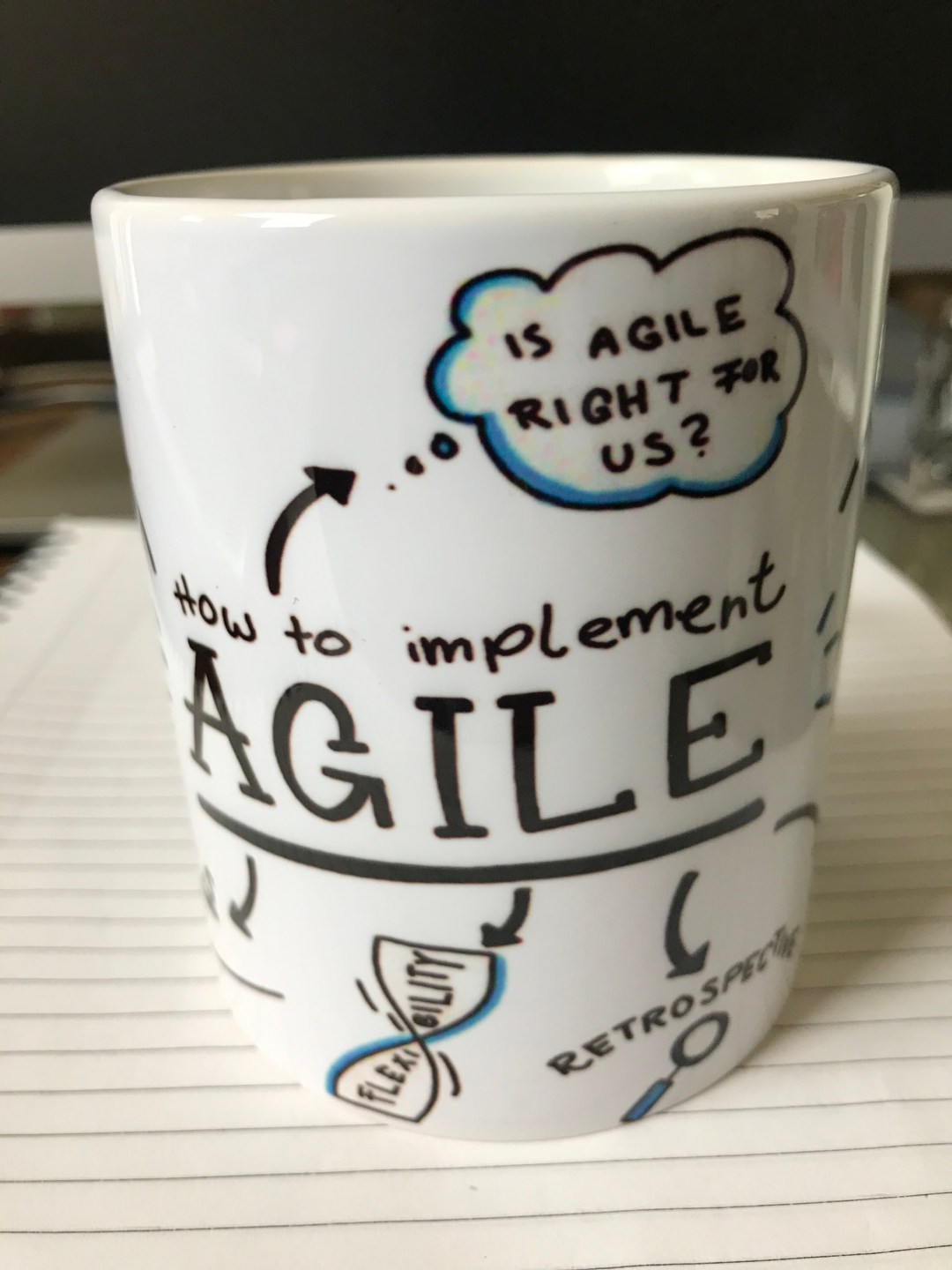
During my time at this company, I worked closely with a group of RPA (Robotic Process Automation) developers. A developer gifted me a coffee mug (which I’m sharing in the image), on which she included all the elements of Agile and Scrum that could fit on the mug. However, one thing caught my eye: the question “Is Agile right for us?”

When I read this, I couldn’t help but feel pride, peace, and a touch of satisfaction. There are two reasons, that I could identify, that triggered these feelings.

Firstly, the simple fact that they had the courage to ask me that question shows that the team is mature enough to openly challenge my own role on the team. This is done with the confidence that no one will take offense as the question comes with good intentions.

The second reason was that, despite questioning whether Agile is what they need, they decided to continue down this path. The team appreciated the culture that Agile brings, such as having open discussions, collaborating together, and challenging each other’s viewpoints.

Once I processed this, I knew that I could leave with the confidence that they will continue seeking opportunities to continually improve their development process while supporting one another. All of this inevitably leads to a sense of satisfaction, knowing that the guidance one has provided is welcomed and valued.

Many thanks to the FPR team for all the lessons you taught me. Until we meet again…

Managing the 4 Toxins Of Communication

One of the most common complaints teams share during retrospectives is “lack of communication” or “communication issues,” which has been investigated and documented for decades. However, when I challenge teams to be more specific about the type of communication that is difficult for them or that presents problems, they struggle to identify them.

While experimenting with this, the exercise that has been most effective is based on the Four Team Toxins, which I first encountered on a site curated by Bob Galen about ORSC (Organization and Relationship Systems Coaching). These 4 toxins were identified by relationship expert Dr. John Gottman, who noticed certain behaviors that get in the way of effective communication and relationships: Blame, Defensiveness, Contempt, and Stonewalling.

According to Conway’s Law, the products we deliver are copies of the communication structures within organizations. Therefore, if we can improve the way we interact with each other, we will enhance the value delivered to our clients.

So, what can we do…

The first thing I ensure is that the team has worked together to craft their social contract or working agreements, where they agree on how to deal with different situations that might arise while working together. This way, we can use this artifact to anchor our conversation about the toxins with the team.

The next step I take is to ask each person to individually write down any behavior they might engage in that could jeopardize at least one item in the Social Contract. I usually leave the option open for sharing their findings with the group as this depends on the level of trust within the team.

Now, we match each behavior with one of the four toxins and begin the conversation about how they manifest:

“I prefer working alone, I don’t need help” (Stonewalling, perhaps?)

“I don’t like it when people tell me I did something wrong” (Defensiveness!)

“This is terrible, your code is a mess…” (Contempt… bordering on bullying)

“It’s not my fault, the other teams always send last-minute requests” (Blame)

This way, from a coaching standpoint, we reflect the team’s findings back to them so they know how each toxin looks in real life.

The Antidote

Now our conversation shifts toward developing the antidote for these toxins. As a team, we share actions we can take to address the toxic behaviors that were identified. With this information, we can show the team how to individually avoid these behaviors and how to support each other as a team in this effort. And even how they can set an example for the rest of the organization.

To wrap up…

At this point, the conversation turns toward how they have the power to identify very specific situations that threaten communication and that they don’t need anyone to keep them in check because they can now spot these behaviors long before they happen, know what actions to take, and how to support each other.

My Favorite Catalyzers (Part 3)

CONTINUOUS IMPROVEMENT

In the two previous installments, I shared two of the three catalysts I use as focal points in my interactions with teams and organizations. To conclude, I’ll share the third one, and it’s likely the one that brings the most lasting and impactful change: Continuous improvement.

Continuous Improvement

Continuous improvement through ongoing learning is the catalyst where I challenge the team to take charge of their future by setting key milestones they want to achieve together. Retrospectives have proven to be an ideal space for a rigorous brainstorming session.

This way, we can identify learning opportunities like cross-training, where each team member shares their knowledge with others. This practice helps level the technical knowledge within the team and takes it to the next level.

Through this effort, empathy within the system increases as team members support each other. One way to enhance this catalyst is to let the team self-organize and design their own learning activities, challenging each other to sustain the change.

Interestingly, of the three, this catalyst presents the greatest challenge when it comes to identifying metrics. After working with several teams and facilitating multiple workshops on the topic, we’ve identified the following metrics:

  • Skills matrix
  • Agility maturity level
  • Code quality
  • Product quality
  • Completed improvement tasks
  • Employee turnover

Conclusion

By focusing on these three catalysts, sustainable change in the company culture can be achieved. This can manifest in increased customer value delivery and greater alignment of individual goals with company objectives. Most importantly, it leads to more fulfilled individuals, creating highly motivated people with ambitious goals for their professional growth.

Thank you very much for taking the time to read this far. I invite you to share what your catalysts are and what changes you’ve noticed in your teams.

See you…

My Three Favorite Catalyzers (Part 2)

FEEDBACK

In the previous installment, we talked about Process Analysis as a catalyst or agent of change. Now I’m going to share with you how we can use feedback to achieve sustainability in the implementation of agility within an organization.

But first… What is a catalyst?

I find it important to quickly revisit what a catalyst is. After reviewing various definitions, the one that caught my attention the most is: a catalyst is a substance that can produce or accelerate a fundamental change in a system without being consumed in the process.

What stands out to me in this definition is the fact that an external element, when interacting with the system, not only brings about change but a fundamental change that remains within the system. This helps make the change permanent, allowing the customer to take ownership of their own change and integrate it into the system. Quite an achievement for agile coaches.

Feedback

The second catalyst I focus on is feedback. First, I guide the team to identify both internal and external customers and to find ways to interact with them. Through this exercise, my goal is to help them see how they are perceived from the outside, the image they reflect, and the value they bring with their product.

The importance of feedback as an agent of change lies in providing the team with purpose, enhancing their sense of pride in the value they deliver. It’s important to channel feedback in three directions:

  • Towards the organization
  • Towards the customer
  • Towards their colleagues

Focusing feedback towards the organization allows the team to understand if the value they’re delivering is aligned with the company’s objectives, ensuring effective interactions with other teams in the process.

When engaging in a conversation with the customer, we ensure that the outcome of the work will bring value and that this value will be utilized, achieving growth for the organization and thus for the team members.

Finally, by focusing on their teammates, they improve collaboration within the system, leading to enhanced quality and value in their work.

Similar to the approach taken with process analysis, the team will identify metrics that enable them to understand how their interactions with these three roles are improving, such as:

  • Customer satisfaction
  • Net Promoter Score
  • Team satisfaction
  • Focus groups
  • Number of bug reports
  • Number of clicks
  • Application or feature usage time

To be continued…

In the next, and final installment, we’ll talk about the third catalyst: Continuous Improvement.

See you…